
Can an Earlier Disability Approval Help Challenge an LTD Denial? A Lincoln National Case Study
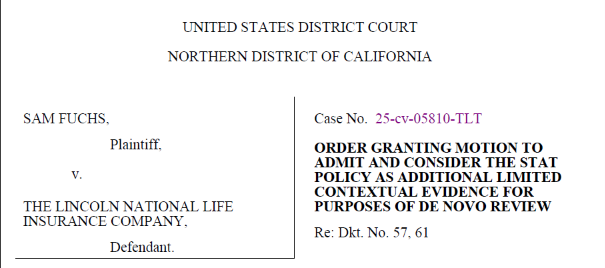
Order granting motion to admit the STAT policy in Fuchs v. Lincoln National Life Insurance Company
An earlier disability approval can help challenge a long-term disability denial, even when the benefits arise under different plans. Its significance depends on the policy definitions, the evidence supporting the approval, and how that evidence is presented during the appeal and litigation.
In Fuchs v. The Lincoln National Life Insurance Company, Dorian Law obtained a federal court ruling allowing consideration of the policy governing an earlier disability approval. The court found that policy necessary to evaluate evidence already in the administrative record.
The opportunity began with a strategic decision during the administrative appeal.
Building the appeal with the next stage in mind
Lincoln had paid the client benefits under Meta Platforms’ California Voluntary Disability Plan, referred to in the litigation as the “STAT” plan, but denied his long-term disability claim.
Brent Dorian Brehm handled the LTD appeal. He recognized that the STAT approval and supporting claim reviews could matter beyond the benefits already paid.
The dispute he sought to isolate concerned the LTD policy’s pre-existing-condition provisions and the meaning of “rehired.” The appeal therefore expressly incorporated the STAT benefit claim file by reference and stated that it proceeded on the basis that disability was established.
That position served a strategic purpose: it called on Lincoln to identify any disagreement about disability during the appeal and preserved an argument about the consequences of failing to do so.
The appeal was designed to shape the issues and evidence available if litigation became necessary. It connected an earlier benefit determination to the LTD claim and made the claimant’s position explicit.
Why an earlier approval needs context
Payment under one disability plan does not necessarily establish eligibility under another. Different plans may apply different definitions, cover different periods, or impose different requirements.
But an earlier approval may still contain useful evidence. Evaluating its significance requires asking:
What definition of disability governed the earlier claim?
What medical and occupational evidence supported payment?
How did that definition compare with the LTD policy?
Did the determinations concern overlapping periods?
The earlier policy supplies part of that context. Without its terms, a court may have difficulty determining what the insurer’s approval actually demonstrates.
That became the issue in Fuchs.
Adapting when the court raised questions
By the hearing on the parties’ motions for judgment, Brehm understood the disability issue to have been resolved through the claim and appeal process. The judge’s questions revealed that the significance of the STAT benefits—and the governing policy—needed further development.
Dorian Law responded with a motion presenting two routes for considering the STAT policy: recognize it as part of the administrative record or admit it as additional evidence necessary for an adequate de novo review.
Lincoln opposed the motion, arguing that the policy was neither relevant nor necessary to review the LTD denial.
Dorian Law’s argument connected the document to the evidence already before the court. The STAT claim file contained an earlier benefit determination. The policy explained the standard governing that determination. The court needed both to evaluate the earlier approval’s significance.
What the court decided
On October 5, 2026, U.S. District Judge Trina L. Thompson granted the motion.
The court recognized that the STAT policy did not govern the LTD claim and that STAT payments did not create a presumption of disability under the LTD policy. Nevertheless, the earlier payments could be relevant evidence.
The court explained:
“Without the STAT Policy, the Court has no way to determine the relevance of Plaintiff’s STAT claims file, and would be forced to simply ignore portions of the administrative record.”
Fuchs v. The Lincoln National Life Insurance Company, No. 3:25-cv-05810-TLT, ECF No. 64, at 4 (N.D. Cal. Oct. 5, 2026).
The court admitted the policy as limited contextual evidence necessary for an adequate de novo review. It declined to decide whether the policy was already part of the administrative record. Id. at 2 n.1, 4.
This was a favorable evidentiary ruling. It did not award LTD benefits or decide that Lincoln had forfeited its ability to dispute disability. It ensured that the court could evaluate potentially favorable evidence with the policy language needed to understand it.
Why the ruling illustrates the Litigation Back Approach
Dorian Law’s Litigation Back Approach considers how choices during a claim or appeal can preserve arguments and create opportunities later.
In Fuchs, that meant identifying an earlier approval, incorporating its supporting claim file by reference, and expressly stating the claimant’s position during the appeal. When the court later needed additional context, the firm pursued a ruling allowing consideration of the governing policy.
The approach adapted as the case developed. The appeal supplied groundwork; the hearing revealed another need; the motion addressed it.
That sequence demonstrates a practical distinction between identifying a helpful fact and developing a strategy that allows a court to evaluate it.
What this means for a denied disability claim
An earlier disability approval deserves careful examination. It may support a later claim, but its value should be developed rather than assumed.
Relevant work may include obtaining both policies, comparing their requirements, reviewing the evidence supporting the earlier decision, and addressing its significance expressly in the appeal.
Timing matters, too. ERISA litigation generally focuses on the administrative record, and opportunities to introduce additional evidence are limited. Under Opeta v. Northwest Airlines Pension Plan for Contract Employees, additional evidence on de novo review must be necessary for an adequate review—not merely helpful. 484 F.3d 1211, 1217–18 (9th Cir. 2007).
The Fuchs ruling illustrates why careful appeal preparation and continued attention during litigation both matter.
Discuss a denied LTD claim with Dorian Law
Dorian Law represents people challenging long-term disability denials through administrative appeals and litigation nationwide. The firm evaluates the policy, claim history, evidence, and reasons for denial to identify potential routes to recovery.
If an insurer approved one disability claim but denied another, Dorian Law can evaluate how the earlier decision may affect the dispute.
Request a free case review, call (747) 297-7409, or email help@dorianlaw.com.
The discussion of appeal strategy and the hearing reflects Brent Dorian Brehm’s firsthand involvement. The court’s findings are identified separately. This article provides general information, not legal advice. Past results do not guarantee future outcomes.