
The Death Certificate Says ‘Accident.’ Why Was the AD&D Claim Denied?
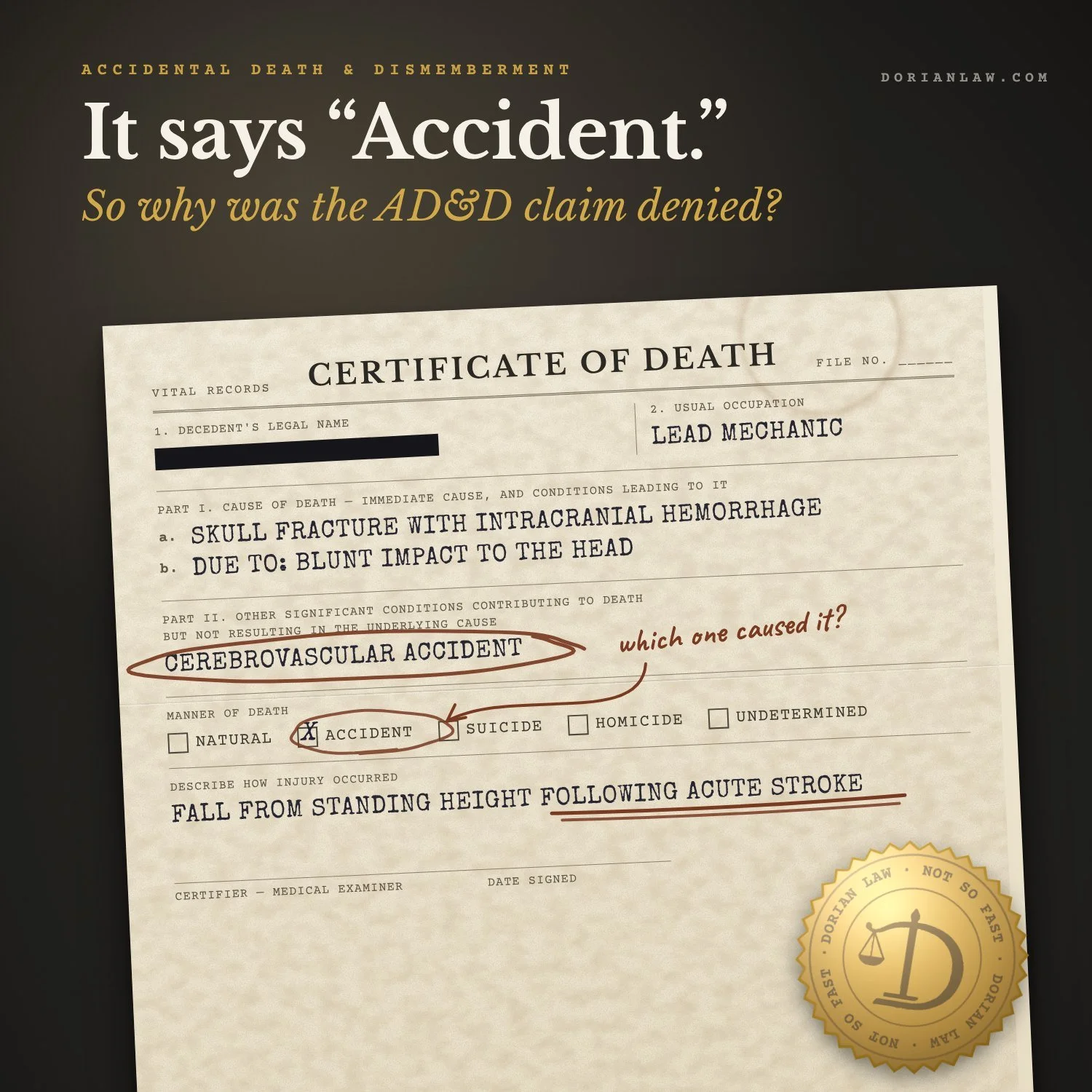
A death certificate that lists the manner of death as “accident” does not by itself entitle a family to accidental death and dismemberment (AD&D) benefits. Most group AD&D policies pay only when the injury caused the death “independent of” illness or other causes. When a stroke, heart attack, or seizure comes before a fatal fall, courts ask whether the medical event substantially contributed to the death. The answer turns on the medical evidence of what actually killed the insured, and on who carries the burden under that policy’s wording.
Your loved one had a medical event, fell, and died from the injury. The medical examiner called it an accident. Then the insurer denied the AD&D claim, saying an illness was involved. A federal court decision from September 2026 shows how this happens, and what an appeal needs to contain if it is going to change the outcome.
What happened in Tegu-Watkins v. Hartford
On June 7, 2024, a lead mechanic covered under a Hartford group AD&D policy suffered a stroke at home, fell, and struck his head on the floor. He died three days later. His widow claimed the basic accidental death benefit. Hartford denied the claim and upheld the denial on appeal. In Tegu-Watkins v. Hartford Life & Accident Insurance Co., No. 8:24-cv-2722 (M.D. Fla. Sept. 25, 2026), the court agreed with Hartford. Dorian Law did not represent either party.
The official records said two things at once:
- Autopsy: cause of death
- Skull fracture with intracranial hemorrhage due to blunt impact to the headOpinion, p. 4
- Autopsy: contributory cause
- Cerebrovascular accident (stroke)Opinion, p. 4
- Manner of death
- Accident: a fall from standing height following acute strokeOpinion, pp. 4–5 (autopsy and death certificate)
- Policy definition of “Injury”
- “bodily damage or harm that must be independent of Illness or any other cause”Opinion, pp. 3–4
On appeal, the family submitted medical records showing he had never been diagnosed with a stroke-related condition. That evidence answered a different question from the one Hartford was asking. The court explained that the issue was not a preexisting condition; it was “whether Decedent’s stroke substantially contributed to his death” (p. 11). The court found the family “did not provide any evidence to show that Decedent’s death was independent of the stroke” (p. 11). It reviewed the claim de novo, giving Hartford no deference, and still held the denial “was not wrong” (p. 15).
Why “accident” on the death certificate doesn’t settle the claim
A medical examiner classifies the manner of death into a small set of categories, such as natural, accident, suicide, homicide, or undetermined, for public-health and legal records. A death that follows a fall is usually classified as an accident even when an illness caused the fall. The AD&D policy asks a different question: whether the accidental injury caused the death without a substantial contribution from illness.
The same autopsy that says “accident” can list the illness as a contributing cause, as it did in Tegu-Watkins. When it does, the certificate supports the insurer’s argument as much as the family’s. The court held that the death certificate and autopsy report, standing alone, did not carry the family’s burden (p. 15).
The question courts ask: did the illness substantially contribute?
Courts generally don’t read “independent of all other causes” literally. Almost every death has some contributing medical factor, and a literal reading would make the coverage close to worthless. Instead, federal courts in several circuits, including the Ninth and Eleventh, ask whether an illness or preexisting condition substantially contributed to the loss. The test is the same across these cases, but the results differ depending on what the medical evidence showed about the illness’s role:
| Tegu-Watkins v. HartfordM.D. Fla. 2026 | Dixon v. Life Ins. Co. of N. Am.11th Cir. 2004 | Dowdy v. Metropolitan Life9th Cir. 2018 | |
|---|---|---|---|
| What came first | Stroke, then a fall | Another driver ran the car off the road | A rollover car crash |
| Medical condition | Acute stroke, with no prior diagnosis | Severe heart disease | Diabetes |
| What the record showed | Autopsy listed the stroke as a contributory cause of death | Cause of death was heart failure; no external injuries | Diabetes complicated wound healing before the leg was amputated, but was not a substantial cause |
| Who had to prove it | The family; the illness language was in a definition, not an exclusion | Not the deciding issue; the heart disease was undisputedly a substantial contributor | MetLife conceded it bore the burden on its illness exclusion |
| Result | Denial upheld | Denial upheld | Coverage owed; reversed |
Sources: Tegu-Watkins, slip op. pp. 4–5, 11, 15 & nn. 8, 10; Dixon, 389 F.3d 1179 (11th Cir. 2004); Dowdy, No. 16-15824, slip op. pp. 4–6, 14–16 (9th Cir. May 16, 2018).
Dowdy matters for families in California and the rest of the Ninth Circuit. MetLife’s policy contained the same kind of “independent of other causes” coverage language. The Ninth Circuit still read the plan as providing coverage unless the condition “substantially contributed” to the loss (slip op. p. 14). As to MetLife’s illness exclusion, it held that “any cause or contribution by an illness or infirmity must be substantial” (p. 16). A condition that was merely “a factor” was not enough. Tegu-Watkins is a Florida district court decision and does not bind courts in other circuits.
Who has to prove it can decide the case
In an ERISA case, the claimant generally must prove the claim is covered, and the insurer must prove that an exclusion applies. Where the illness language appears in the policy can therefore shift the case. In Tegu-Watkins, the “independent of Illness” requirement sat in the definition of “Injury,” not in the exclusions section. The court therefore held that the family had to prove the death was independent of the stroke (n. 10, p. 15). Hartford did not have to prove the stroke caused it. In Dowdy, MetLife carried the burden on its exclusion and could not meet it.
Many AD&D policies contain both a coverage definition and an illness exclusion. A denial letter that cites only one of them is telling you which fight the insurer has chosen. The appeal has to answer that provision with evidence.
How we build an AD&D appeal when a medical event came first
We use the Litigation Back Approach. We start from what a federal judge would need to see to rule for the family, and then build the administrative appeal to contain it. In an ERISA case, the appeal record is usually the only evidence the court will ever review.
-
Identify the exact provision behind the denial
We read the denial letter against the full policy and plan documents. We determine whether the insurer relies on the coverage definition, an illness or sickness exclusion, or both, because that tells us who carries the burden and what has to be proved.
-
Get the complete claim file before writing anything
ERISA regulations entitle the family to the documents and records relevant to the claim, free of charge, on request (29 C.F.R. § 2560.503-1(h)(2)(iii)). We request the file, along with every medical reviewer’s report the insurer relied on.
-
Build the chronology from the earliest records
The sequence of events is usually the whole case. The records that establish it are often missing from the claim file:
- The 911 call record and the EMS run report
- Emergency department triage notes and the timing of the first imaging
- The medical examiner’s investigative report, not just the certificate
- The hospital course between the fall and the death, including any neurology consults
-
Ask a physician the question the policy asks
An opinion that the death was “accidental” adds nothing to what the death certificate already says. A useful opinion addresses the substantial-contribution question directly. Would the medical event, without the fall, more likely than not have been fatal? Which injury actually caused the death? What role, if any, did the illness play after the fall? The opinion has to deal with any record that cuts against it, including an autopsy that lists the illness as contributing.
-
Put everything in before the appeal closes
Even under de novo review, courts in Tegu-Watkins (p. 8) and Dowdy (slip op. p. 8) limited themselves to the record before the insurer, apart from narrow exceptions. Evidence that isn’t in the appeal will almost certainly never be considered.
Deadlines are shorter than many families expect
For an ERISA-governed AD&D claim, the plan must give at least 60 days after you receive the denial to file an administrative appeal (29 C.F.R. § 2560.503-1(h)(2)(i)). That is shorter than the 180 days disability claimants get. Your plan may allow more time, and the denial letter should state the deadline. Many plans also set a separate deadline for filing a lawsuit after the appeal is denied.
An individual AD&D policy you bought yourself, rather than through an employer, is usually not governed by ERISA. State insurance law then controls, and the rules on interpretation, burden, and remedies can be very different, sometimes including bad-faith damages. Identify which body of law governs before you choose an appeal strategy.
Frequently asked questions
Not automatically. The death certificate’s “manner of death” is a medical examiner’s classification, while an AD&D policy usually requires that the injury caused the death independent of illness. In Tegu-Watkins v. Hartford (M.D. Fla. 2026), the death certificate and autopsy both said “accident,” yet the court held they did not prove coverage because the autopsy also listed a stroke as a contributory cause.
Not necessarily. Federal courts in several circuits ask whether the illness substantially contributed to the death, not whether it played any role at all. The outcome depends on the medical evidence of what actually caused the death, the exact policy wording, and the law of the circuit where the case is decided. A family can lose a winnable claim by submitting evidence that doesn’t answer that question.
It requires the accidental injury, not an illness, to be the cause of the death or loss. Courts generally do not read it literally. In Dowdy v. Metropolitan Life (9th Cir. 2018), the Ninth Circuit read MetLife’s “independent of other causes” language to provide coverage unless a condition substantially contributed, and it held that the insured’s diabetes, although a factor, did not.
It depends on where the illness language appears in the policy. Under ERISA, the claimant generally proves coverage and the insurer proves exclusions. In Tegu-Watkins, the “independent of Illness” requirement was in the definition of “Injury,” so the family carried the burden. In Dowdy, MetLife carried the burden on its illness exclusion and could not meet it.
Not by itself. In Tegu-Watkins, the family submitted records showing no prior stroke-related diagnosis. The court said the question was whether the acute stroke substantially contributed to the death, not whether there was a preexisting condition. Evidence about medical history has to be paired with evidence about what actually caused the death.
For an employer-provided AD&D policy governed by ERISA, the plan must allow at least 60 days after you receive the denial, under 29 C.F.R. § 2560.503-1(h)(2)(i). Some plans allow longer, and the denial letter should state the deadline. Individual policies governed by state law have different rules, so confirm the deadline the day the denial arrives.
Usually not in an ERISA case. Courts generally review only the record that was before the insurer when it decided the appeal; both Tegu-Watkins and Dowdy applied that limit even under de novo review. Causation evidence such as EMS records, the medical examiner’s investigative report, and a physician’s opinion should be in the administrative appeal.
Dorian Law P.C. is a California-based firm whose entire practice is life, disability, and accidental death insurance denials and ERISA benefit disputes, handled nationwide. Founding shareholder Brent Dorian Brehm has represented claimants since 2006. The firm builds AD&D appeals using its Litigation Back Approach, assembling the causation evidence a federal court would need before the administrative appeal closes. Consultations are free at dorianlaw.com/contact or (747) 297-7409.
Send us the denial letter and the policy
We will tell you which provision the insurer is relying on, who has to prove what, and what evidence the appeal needs before the deadline runs. Dorian Law handles AD&D denials nationwide. If your claim is with Hartford, see our Hartford accidental death denial page.
This article is general information, not legal advice, and reading it does not create an attorney-client relationship. Outcomes depend on the policy language, the evidence, and the governing law. Case descriptions reflect the cited opinions as of October 2026 and do not report later appellate history. Dorian Law did not represent any party in the cases discussed.